
Custom development vs off-the-shelf software is a decision almost every growing business runs into eventually, usually right after realising that the free trial spreadsheet tool or generic SaaS plan they started with can’t keep up with how the business actually works anymore. Both paths solve real problems. One gets you running fast with minimal upfront cost, the other gives you software built exactly around your business operations. In this guide, we’ll walk through what each option actually means, where each one genuinely wins, and how Indian businesses in particular should think about the trade-off, since local compliance, pricing, and talent availability change the calculation quite a bit.
What Is Custom Software Development?

Custom application development means building software from the ground up, or significantly extending an existing platform, to match your specific business processes rather than adjusting your processes to fit someone else’s product. It starts with a proper discovery phase, understanding your workflows, pain points, and goals, and results in a solution designed only for your company, that you own outright.
Because it’s built around your actual digital workflows instead of a generic template, custom software tends to fit the way your team already works, rather than forcing them to learn a new way of doing things. It’s owned entirely by your business, meaning you control the roadmap, the data, and how it evolves as you grow.
What Is Off-the-Shelf Software?
Off-the-shelf software, sometimes called packaged software, is built once and sold to thousands of businesses with roughly similar needs. Think of standard accounting tools, CRM platforms, or HR software you can sign up for today and start using within hours. It’s designed for the average user in a given category, which is exactly what makes it fast to deploy and relatively cheap to start with.
The trade-off is that packaged software wasn’t built with your specific workflows in mind. You get a wide set of features, but you’ll likely use only a fraction of them, while the one or two things your business actually needs might not be there at all.
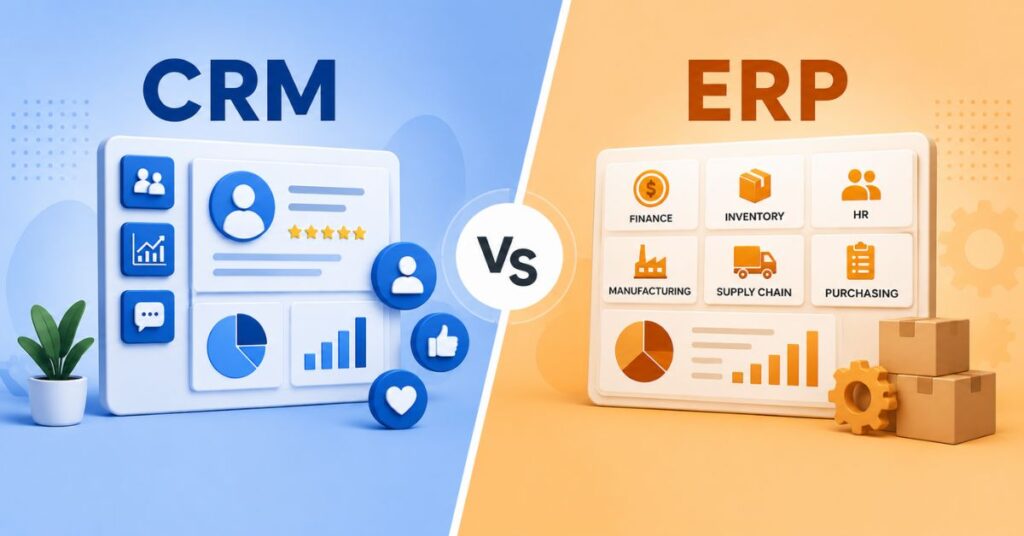
Also Read: CRM vs ERP: What’s the Difference and Which One Does Your Business Need?
Custom Software vs Off-the-Shelf: The Core Differences
| Factor | Custom Software | Off-the-Shelf Software |
|---|---|---|
| Fit to your business | Built around your exact workflows | Built for a broad, average user |
| Ownership | You own the software outright | You’re licensing someone else’s product |
| Upfront cost | Higher | Lower |
| Long-term cost | Often lower over time, no recurring license fees | Can climb steadily with users, upgrades, and add-ons |
| Time to launch | Weeks to months, depending on scope | Immediate to a few days |
| Software customization | Unlimited, it’s your codebase | Limited to what the vendor allows |
| Software scalability | Scales exactly how your business needs it to | Scaling often means a higher pricing tier or hitting a feature ceiling |
| Support | You manage it, or your development partner does | Vendor handles updates and support |
Advantages of Custom Software Development
The benefits of custom software development show up most clearly once a business has outgrown what generic tools can offer.
Built around your actual processes. Custom software starts with an in-depth look at how your business really operates, not how a product manager three time zones away imagined an “average” company operates. The result fits your workflows instead of the other way around.
Full ownership and control. You own the code, the data, and the roadmap. Nobody else decides when a feature gets removed or a pricing tier changes overnight.
Centralized data on your terms. Since the system is built for you, you control exactly how data flows between departments, which matters a lot for centralized data and operational visibility across finance, sales, and operations.
Unlimited customization and scalability. As your business grows or pivots, the software grows with it. You’re not stuck waiting for a vendor’s product roadmap to catch up with what your business needs today.
Better long-term economics. No per-user license fees stacking up every year. Once built, you’re paying for maintenance and updates, not renting access to a tool forever.
A genuine competitive edge. When your competitors are all using the same off-the-shelf CRM or ERP, differentiation gets hard. Custom software lets you build something your competitors literally cannot buy.
Disadvantages of Custom Software- Custom Development vs Off-the-Shelf Software
It’s not without trade-offs, and being upfront about them matters.
Higher upfront investment. You’re paying for design, development, and testing from scratch, so custom software development cost is naturally higher than a monthly SaaS subscription.
Longer timeline. Depending on scope, a custom build can take anywhere from a couple of months to over a year, compared to signing up for packaged software the same day.
Requires ongoing management. Someone needs to own the relationship with your development team or in-house developers for updates, security patches, and future enhancements.
Also Read: ERP Implementation Guide: Benefits, Process & Common Mistakes
Advantages of Off-the-Shelf Software- Custom Development vs Off-the-Shelf Software
Packaged software earns its popularity for good reasons.
Immediate availability. No development timeline. You sign up and start working the same day.
Lower upfront cost. Subscription pricing spreads the cost out, and many tools offer free trials so you can test before committing.
Broad feature sets. Built for a wide market, so you often get more functionality than a lean custom build would include on day one.
Vendor-managed support and updates. Bug fixes, security patches, and new features roll out automatically, without you needing an in-house or outsourced dev team on standby.
Large user communities. Popular tools have active forums and documentation, which makes troubleshooting faster for common issues.
Disadvantages of Off-the-Shelf Software
The convenience comes with real limitations that tend to surface as a business grows.
Costs creep up over time. Per-user pricing, add-on modules, and forced upgrades mean the “cheap” option can quietly become expensive as your team grows.
You adapt to the software, not the other way around. If a workflow doesn’t fit the tool, you either change your process or pay for a workaround.
Vendor dependency. The provider decides when features change, when prices go up, or when support ends. If they shut down or get acquired, you’re left scrambling for an alternative.
Weak differentiation. When every business in your industry uses the same packaged software, it stops being a competitive advantage and becomes table stakes.
Custom Software Development Cost in India
Custom application development cost in India varies widely based on scope, but it’s genuinely more affordable here than hiring a similarly experienced team in the US or Western Europe, which is a big reason software outsourcing to India has grown so much.
- Simple internal tools or MVPs: Roughly 3 to 10 lakh rupees.
- Mid-complexity business applications (custom CRM, inventory system, booking platform): Roughly 10 to 40 lakh rupees.
- Large, complex enterprise systems with multiple integrations: 50 lakhs and upward, depending on scale.
What actually drives the final number is development complexity, the number of integrations needed, design requirements, data migration from existing systems, and ongoing maintenance after launch. A reliable custom application development company will walk you through these cost drivers upfront rather than quoting a flat number without context.
Custom Software Examples- Custom Development vs Off-the-Shelf Software
To make this concrete, here’s where custom software typically shows up:
- A manufacturing business building a production tracking system tailored to its exact machine and shop floor workflow.
- A logistics company building custom route optimisation software instead of forcing generic fleet software to work around local delivery patterns.
- A healthcare provider building a patient management system that fits Indian regulatory and data privacy requirements exactly.
- A retail chain building an inventory and billing system that natively handles GST, multi-branch stock, and regional language support.
Large global platforms like Amazon and Netflix are extreme examples of this same principle. Their recommendation engines and logistics systems are custom-built because no packaged software could ever replicate their specific scale and workflows.
Custom Software for Small Business: Does It Make Sense?
This is where the “custom software for small business” question gets interesting. Custom development isn’t only for large enterprises. It makes sense for a small business when:
- Your core operations are unusual enough that generic tools force awkward workarounds.
- You’re stitching together three or four different tools just to run one process, and none of them talk to each other properly.
- You expect meaningful growth in the next couple of years and don’t want to rebuild your tech stack every time you outgrow a plan.
If your needs are fairly standard, invoicing, basic CRM, email marketing, off-the-shelf software is still usually the smarter starting point. Save the custom investment for the part of your business that actually needs it.
SaaS vs Custom Software: A Practical Middle Ground
It’s worth noting that SaaS vs custom software isn’t always an either-or decision. Plenty of businesses run a hybrid setup, using off-the-shelf SaaS tools for non-core functions like team messaging or email, while investing in custom software only for the specific processes that directly drive their competitive advantage. This approach keeps costs sensible while still solving the workflow gaps that generic tools can’t.
Choosing a Custom Application Development Company
If you decide custom is the right path, the partner you choose matters as much as the decision itself. Look for a custom application development company that offers genuine software consulting services upfront, meaning they ask detailed questions about your business operations before writing a single line of code, rather than jumping straight into a proposal.
Check their track record with businesses of a similar size and industry in India, since local compliance requirements, like GST-ready invoicing or data localisation, aren’t always understood by teams that mostly work with international clients. Ask how they handle post-launch support, since a custom build is only valuable if someone can maintain and extend it once it’s live.
For a deeper walkthrough of the full custom development process, from planning through to deployment, our custom software development guide for Indian businesses covers what to expect at each stage and how to avoid the most common pitfalls.
Also Read: The Complete Guide to Custom software development company for Indian Businesses
Which One Is Right for Your Business?
There’s no universal right answer, only the right answer for where your business is today.
Choose off-the-shelf if: you need something running quickly, your needs are fairly standard, budget is tight right now, or the function isn’t core to your competitive advantage.
Choose custom software if: your workflows are genuinely unique, you’re stitching together too many disconnected tools, you want full ownership and control over your data, or the process you’re solving for is central to how your business wins against competitors.
Many businesses land somewhere in between, running packaged software for the basics while investing in a custom build for the one or two processes that actually define how they operate.
Interesting Reads:
Website Conversion Optimization: 10 Proven Strategies to Increase Leads
AI Website Development: What Business Owners Really Need to Know