
Custom software development cost is usually the first question business owners ask once a spreadsheet breaks down, an off-the-shelf SaaS tool hits its limits, or a manual process finally becomes too expensive to keep running. The honest answer is that the range is wide, a simple internal tool can cost a few lakh rupees while a complex enterprise platform can run into a crore or more, and where your project lands depends on decisions you make before a single line of code gets written. This guide breaks down exactly what drives that number, realistic price bands by project type, the hidden costs most quotes leave out, and how to get an estimate you can actually trust.
What Actually Drives Custom Software Development Cost
Most quotes get compared purely on the final number, but the number only makes sense once you understand what’s behind it.
Core logic complexity. A simple app where people log in and manage basic data is one kind of build. A system with multi-tenant architecture, complex permission rules, real-time processing, or a custom algorithm is an entirely different engineering challenge, and it’s priced accordingly.
Feature count. Every feature has to be designed, built, tested, and maintained going forward. Most businesses overestimate what they actually need in version one. Trimming scope early is the single biggest lever for controlling cost.
Who’s using it. A consumer-facing product needs proper UI/UX design investment since strangers will judge it in seconds. An internal tool your own team uses daily needs far less design polish and more focus on speed and reliability.
Third-party integrations. Connecting to a payment gateway is straightforward. Connecting to a legacy ERP through a poorly documented API, or pulling data from a government portal, adds real time and cost. Every integration should be scoped individually, not lumped into a vague “integrations” line item.
Engineering team composition. A senior-heavy engineering team costs more per hour but often ships faster with fewer bugs. A junior-heavy team costs less per hour but can take longer and need more QA cycles to reach the same quality bar.
Quality assurance. Skipping proper testing is how bugs end up in production. Budgeting 15 to 20 percent of development time for QA isn’t optional, it’s the difference between software that works and software that works reliably.
Also Read: ERP Implementation Guide: Benefits, Process & Common Mistakes
Custom Software Development Cost by Project Type
These ranges reflect what businesses in India typically pay for a quality engineering team, not bottom-tier freelance rates and not premium Western agency pricing.
| Project type | Typical cost range (INR) | Typical cost range (USD) |
|---|---|---|
| Simple internal tool or MVP | 4 lakh to 15 lakh | $5,000 to $18,000 |
| Mid-complexity business application | 15 lakh to 65 lakh | $18,000 to $80,000 |
| Enterprise software, CRM or ERP | 65 lakh to 1.6 crore | $80,000 to $200,000 |
| Complex enterprise platform, multi-location or heavy compliance | 1.6 crore and above | $200,000 and above |
Building in phases rather than trying to launch everything at once is one of the most reliable ways to keep a project on budget. Trying to build the full vision in one go is how businesses end up eighteen months in, budget exhausted, and still not live.
ERP Software Development Cost
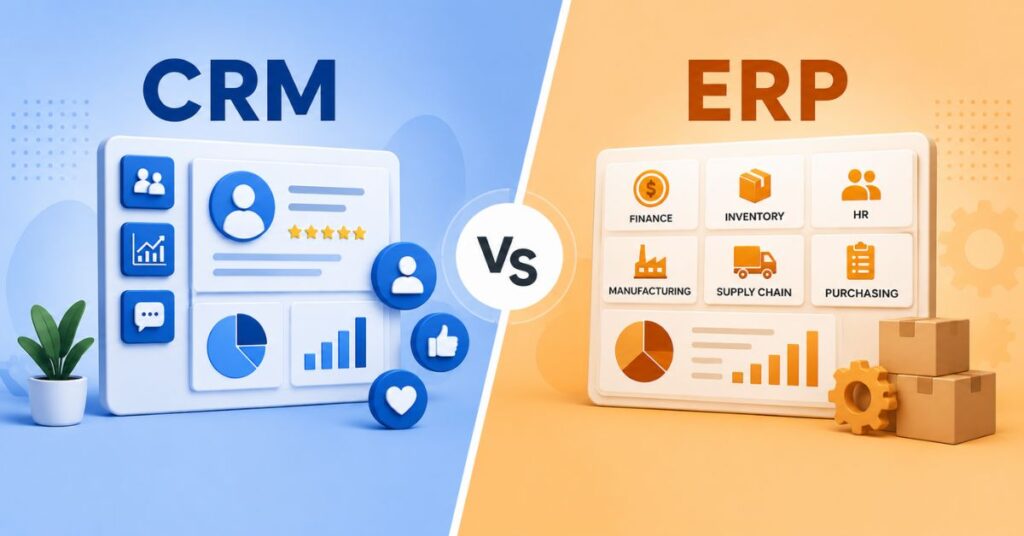
ERP software development cost deserves its own breakdown since it’s one of the most expensive and highest-stakes categories of custom software. A dedicated ERP covering the modules a mid-sized business actually needs, finance, inventory, and basic reporting, typically runs 65 lakh to 1.6 crore. Add compliance requirements, multi-location support, and integration with legacy systems, and that figure moves into the 1.6 crore to 3.5 crore range or higher.
For Indian businesses, GST-ready invoicing, e-invoicing, and TDS handling need to be built in from the start rather than bolted on afterward, since retrofitting compliance logic into an existing system is far more expensive than planning for it upfront. Phased ERP builds, starting with finance and inventory and expanding module by module, consistently come in more predictable than trying to launch a full system on day one.
Also Read: How to Optimize WordPress Website Speed (Complete Guide)
Mobile App Development Cost India
Mobile app development cost in India varies mainly based on platform choice and feature depth.
- Single platform, basic backend, simple flows. 8 lakh to 25 lakh.
- Mid-complexity app with user accounts, APIs, and proper UX: 25 lakh to 65 lakh.
- Feature-rich app with real-time features or e-commerce: 65 lakh to 1.2 crore and up.
If you need both iOS and Android, cross-platform frameworks like React Native can shave 25 to 35 percent off the total cost compared to building two fully native apps, and the output is genuinely production-ready for most business use cases today.
Using a Software Development Cost Calculator
A proper software development cost calculator isn’t a magic number generator, it’s really a structured way of breaking your project into parts before you ask anyone for a quote. The rough formula looks like this:
Estimated cost = (development hours × blended hourly rate) + design cost + QA (15 to 20 percent of dev cost) + project management + a contingency buffer of 15 to 20 percent
To use it properly, break your project into individual features, estimate hours per feature separately rather than guessing at the whole project in one go, and price design and QA as their own line items instead of assuming they’re bundled in “for free.” This is also exactly what a good software development partner should hand you, a feature-level breakdown, not a single vague number.
The Hidden Costs Nobody Mentions Upfront
The development budget covers building the software. It doesn’t cover everything that comes after.
- Annual maintenance: Typically 15 to 20 percent of your build cost every year, covering bug fixes, compatibility updates, and small enhancements.
- Security: Patches and periodic audits, especially critical if you’re handling payment data or personal information.
- Infrastructure costs: Your hosting bill at 100 users looks nothing like your bill at 100,000. Get realistic traffic estimates from your engineering team before launch.
- Third-party service costs: Payment gateways, SMS APIs, and mapping services usually charge per transaction, and these costs scale directly with your growth.
- Post-launch iteration: Real users will surface things your team missed in planning. Reserve budget for a few sprints after launch rather than assuming version one is the final version.
A reasonable rule of thumb is to add 20 to 25 percent of your build cost annually for ongoing costs, and to plan for that from day one instead of getting surprised by the first renewal invoice.
Hiring Software Developers in India: Rates and Models
If you’re planning to hire software developers in India directly rather than going through a development partner, rates typically fall between 1,500 and 5,000 rupees per hour depending on seniority and specialisation, with senior engineers and niche skills like cloud architecture or machine learning at the higher end.
There are generally three engagement models to choose between:
Fixed price works well when your scope and requirements are locked and unlikely to change, giving you cost certainty upfront.
Time and material suits projects that will evolve as you learn more, which describes most real-world software projects. Regular sprint reviews keep this model flexible without losing control of the budget.
Dedicated team makes sense for ongoing, long-term product development, where you want a consistent engineering team embedded with your business rather than a one-off project handoff.
Building a Realistic Software Development Budget
Getting an estimate you can actually trust depends almost entirely on the quality of your brief. A vague brief produces a vague, usually inflated, estimate.
- Start with the problem, not the feature list. Describe what needs to improve, not a list of screens you imagine needing. Features should emerge from the actual problem.
- Separate must-haves from nice-to-haves before any scoping call. This single habit typically cuts 20 to 30 percent off a first-pass estimate.
- Ask for a feature-level breakdown, not one flat number, so you can make real trade-offs instead of guessing where the cost is coming from.
- Lock your tech stack before finalising budget. Changing direction mid-project is expensive and usually avoidable with better upfront planning.
- Insist QA appears as its own line item. If a quote doesn’t show testing time separately, ask where it’s hidden.
Getting two or three quotes is worth doing, not to chase the lowest number, but to see where different teams are scoping the work differently. A large gap between quotes almost always means someone missed something.
Choosing the Right Software Development Partner
The cheapest quote is rarely the best deal once you factor in rework, missed deadlines, and poor communication. A good software development partner offers genuine software consulting and IT consulting services upfront, asking detailed questions about your business before writing a proposal, rather than jumping straight to a price.
Look for a track record with businesses of a similar size in your industry, clear IP ownership terms so you fully own the code you’re paying for, and transparency about what’s included versus billed separately. For software outsourcing India specifically, cities like Bangalore, Pune, Gurugram, and Mumbai have decades of experience delivering for international and domestic clients alike, which shows in how smoothly time zones, communication, and milestone structures tend to run.
If you’re still deciding between building custom software or configuring an off-the-shelf tool, our custom software development guide for Indian businesses walks through that decision in more depth, along with what to expect at each stage of a custom build.
Interesting Reads:
CRM vs ERP: What’s the Difference and Which One Does Your Business Need?
Website Design Company: The Complete Guide to Professional Website Design & UI/UX Services
Website Conversion Optimization: 10 Proven Strategies to Increase Leads